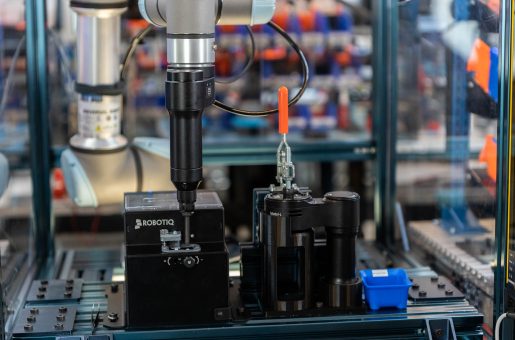
A screw that is tightened incorrectly can compromise an electronic product even when every circuit and component functions as intended. Excessive torque may crack plastic housings, deform mounting points, or damage printed circuit boards, while insufficient tightening can leave components vulnerable to vibration. These problems become more difficult to control when assembly involves hundreds of fastening operations across different product variants. Automated screwdriving addresses this challenge by combining controlled fastening equipment with repeatable positioning, process monitoring, and consistent screw delivery.
Why Fastening Accuracy Matters in Electronics
Electronic assemblies frequently combine materials with different mechanical properties. Metal inserts, polymer housings, circuit boards, and threaded components respond differently to tightening forces, making a single fastening strategy unsuitable for every connection. Engineers must therefore specify torque requirements according to the joint design rather than relying on general assumptions about screw size.
Torque is particularly important because it provides an indirect indication of the clamping force generated during fastening. However, the relationship between torque and preload is affected by friction, thread condition, surface finish, and material properties. Two apparently identical screws tightened to the same torque may consequently produce different clamping forces.
Small fasteners create additional difficulties. Their limited dimensions leave little room for positioning errors, and damaged threads can be difficult to detect during manual assembly. Automated systems help improve repeatability, provided that screw presentation, tool alignment, and fastening parameters are properly controlled.
How Robotic Screwdriving Systems Work
An automated screwdriving station typically combines a fastening tool, screw-feeding equipment, a positioning mechanism, and a controller. The positioning mechanism may be a dedicated linear assembly system or an industrial robot capable of reaching multiple fastening points. Screws are delivered to the tool through an appropriate feeding arrangement before being driven into the workpiece.
Robotic systems are particularly useful when products contain fasteners at several locations or orientations. Instead of moving the entire assembly between separate fastening stations, a robot can position the tool at successive screw locations. This flexibility can reduce the need for dedicated mechanical fixtures in applications where the same equipment handles multiple product variants.
Modern fastening tools can incorporate torque control, screw detection, and process feedback. A robot screwdriver designed for automated assembly can combine programmable torque settings with checks that help identify missing screws or unsuccessful insertion. OnRobot’s system, for instance, supports specified tightening torques between 0.15 and 5 Nm and compatible metric fasteners from M1.6 to M6, making it relevant to various electronics and general assembly applications.
The robot’s movements must also be coordinated with the tool’s axial motion. If the screwdriver approaches a fastening point at an incorrect angle, the screw may enter the thread improperly or damage the surrounding material. Accurate fixturing and suitable approach trajectories are therefore essential even when the fastening tool itself provides precise torque control.
Detecting Fastening Errors Before They Become Defects
One of the most useful aspects of automated screwdriving is the opportunity to monitor individual fastening operations. Instead of treating each screw as a completed action once the tool stops rotating, the system can evaluate whether the process behaved as expected. Depending on the equipment, this may involve monitoring torque, rotation, insertion depth, or fastening time.
A missing screw can sometimes be detected before the tool reaches the assembly. Other faults, such as cross-threading or an incorrectly seated fastener, may produce abnormal torque behavior during insertion. Identifying these conditions allows the production system to stop, reject the assembly, or request operator intervention.
However, torque monitoring alone cannot establish that every joint is mechanically sound. A damaged thread may produce an apparently acceptable torque reading without generating the intended clamping force. Critical applications may therefore require additional verification methods, including torque-angle monitoring, joint testing, or periodic destructive evaluation.
Traceability becomes especially valuable when fastening data is associated with individual products. Manufacturers can retain information about completed operations and investigate recurring defects across production batches. This supports process improvement and helps identify whether failures originate from components, tooling, or assembly conditions.
Electrostatic Discharge and Component Protection
Electronics manufacturing introduces requirements that are less prominent in conventional mechanical assembly. Electrostatic discharge can damage sensitive semiconductor components, sometimes without producing an immediately visible failure. Automated fastening equipment must therefore be assessed as part of the facility’s broader ESD control program.
Suitable materials, grounding arrangements, and equipment design help reduce electrostatic risks. Nevertheless, selecting an ESD-compatible screwdriver does not automatically make the complete robotic cell compliant with applicable requirements. Fixtures, cables, operators, work surfaces, and other equipment must also be considered.
Mechanical protection is equally important. Printed circuit boards can flex when fastening forces are applied without adequate support, potentially stressing solder joints or mounted components. Well-designed fixtures support the assembly near fastening locations and maintain consistent positioning throughout the operation.
Managing Product Variants and Changeovers
Electronics manufacturers often assemble several product versions using similar production equipment. Different housings may require alternative screw lengths, fastening sequences, or torque settings. A robotic system can accommodate these differences through stored process recipes, provided that the appropriate tools and feeding equipment are available.
Changeover performance depends on more than software configuration. Screw feeders may require mechanical adjustments, replacement parts, or different handling arrangements when fastener dimensions change. Manufacturers should validate each supported screw type rather than assuming that a nominal size range guarantees compatibility.
For low-volume production, setup time can become a major economic consideration. A flexible robotic station may be preferable to dedicated automation if it can handle several products without extensive reconfiguration. Conversely, a fixed high-speed screwdriving system may offer better throughput for standardized products manufactured in large quantities.
When Automated Fastening Delivers the Greatest Value
Automated screwdriving is particularly attractive when fastening operations are repetitive, quality-sensitive, or ergonomically demanding. It can also be useful where manufacturers need consistent process records or must reduce the variability associated with manual assembly. These benefits should be evaluated alongside equipment costs, integration effort, maintenance, and expected production volumes.
The most successful installations treat fastening as a controlled manufacturing process rather than a simple rotational movement. Joint design, screw quality, fixturing, torque requirements, and error detection all influence the final result. As electronic products become more compact and mechanically complex, reliable fastening will remain an important part of manufacturing quality assurance.